

Dry Scalp vs. Product Buildup: Key Differences
Scalp Health, Natural Hair Care, Dry Scalp vs Product Buildup
Dry Scalp vs. Product Buildup: How to Tell the Difference
If your scalp has been feeling itchy, flaky, or uncomfortable, you are not alone. Many women with natural, curly, coily, kinky, and textured hair assume that any itch or flake means their scalp is dry and needs more oil. But sometimes the real issue is not dryness at all, it is product buildup on the scalp. Understanding the difference between dry scalp vs product buildup can completely change how your hair and scalp feel from wash day to wash day.
Itchy or Flaky Does Not Always Mean “Dry”
When your scalp starts itching or you notice flakes on your shoulders, it is easy to reach for more oil, more grease, or another “moisturizing” product. But an itchy scalp or flaky scalp does not automatically mean your scalp is dry. In many cases, especially with natural hair scalp care, the real problem is scalp buildup from:
Oils and butters (including natural oils)
Creams, leave-ins, and styling milks
Gels, mousses, and curl definers
Edge control and pomades along the hairline and partings
Sweat, environmental debris, and old product that was never fully removed
Over time, these layers can sit on the scalp and hair, making it feel itchy, tight, and uncomfortable—very similar to how true dry scalp natural hair can feel. That is why it is so important to understand what is actually going on before you decide what to put on your scalp next.
Dry Scalp vs. Product Buildup: What Is the Difference?
When I talk to clients at Harmony Strands about dry scalp vs product buildup, I like to keep the explanation simple and clear. Both can cause itching and flaking, but they come from very different causes and need different solutions.
What Is Dry Scalp?
A dry scalp happens when your scalp does not have enough moisture or natural oils to feel comfortable. The skin on your scalp is skin, just like the rest of your body. It can feel tight, itchy, and sensitive when it is not properly hydrated or when something in your routine is stripping away too much of your natural oil. Dry scalp is about the condition of the skin, not about how many products are sitting on top of it.
What Is Product Buildup on the Scalp?
Product buildup on scalp happens when oils, creams, gels, edge control, and other styling products are layered on over time without being fully removed. This can mix with sweat, dead skin cells, and environmental debris. Instead of your scalp being clean and able to breathe, it is covered by a film of residue. That residue can:
Make your scalp feel itchy or irritated
Block moisture from getting where it needs to go
Make your hair feel heavy, coated, or greasy at the roots
So while a dry scalp is about not enough moisture within the skin, scalp buildup is about too much product and residue sitting on top. Both can show up with flakes and itching, but the way I help you address them will be different.
Signs Your Scalp May Be Dry
Everyone’s scalp is different, and I do not diagnose medical scalp conditions. But there are some common signs that suggest your scalp may be on the drier side rather than simply coated with product. You might be dealing with dryness if you notice:
A tight, uncomfortable feeling on your scalp, especially after washing or drying your hair
Small, light-colored flakes that look more like dry skin than clumps of product
Itching that does not improve even after a gentle cleanse and proper rinsing
Sensitivity or tenderness when you scratch, brush, or part your hair
Your scalp looks dull, ashy, or rough instead of smooth and healthy
Dryness can be influenced by your cleansing habits, the products you use, the weather, and even how much water you drink. If you suspect true dryness, it is important to look at both your moisture routine and your cleansing products to make sure they are not stripping your scalp too harshly.
Signs You May Have Product Buildup
With natural and textured hair, it is very common to use multiple products to style, define, stretch, and protect your curls and coils. The challenge is that all of those products can build up over time. You may be dealing with scalp buildup instead of dryness if you notice:
Your hair feels coated, waxy, or “filmy,” especially at the roots and along your partings
Your styles are not lasting as long, or your curls are not popping like they used to, even though you are using the same products and techniques
Your scalp feels itchy or “crawly” soon after applying oils, creams, or edge control, especially if you are layering multiple products at once
You can literally see product sitting on your scalp or clumping at the base of your twists, braids, or parts
Your roots feel heavy and weighed down, even when your ends feel dry
Another clue is how your hair responds on wash day. If your shampoo is not lathering well, or you have to wash multiple times and still feel coated, that is often a sign that product buildup on scalp and hair is getting in the way. That is when a conversation about clarifying shampoo and cleansing technique becomes important.
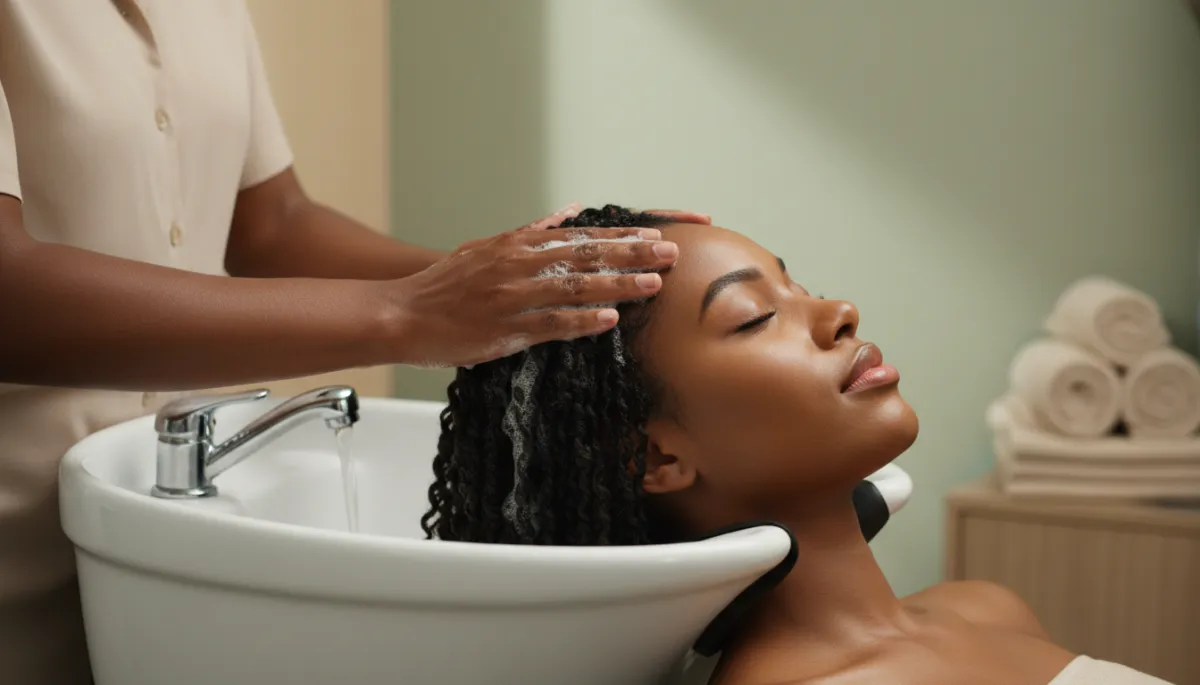
A thorough, gentle cleanse often reveals whether you are dealing with dryness or buildup.
Why Product Buildup Can Feel Like Dryness
One of the most confusing parts of natural hair scalp care is that scalp buildup can mimic the feeling of dryness. When there is a film of product sitting on your scalp, your skin may not be getting the balance of cleanliness, moisture, and airflow it needs. That can lead to:
Itching that makes you want to scratch constantly, especially under protective styles or along the hairline
Flakes that are actually dried product or a mix of product and dead skin, not just dry skin alone
A tight, uncomfortable feeling because the scalp is not truly clean
When that happens, it is very easy to reach for more oil to “soothe” the scalp. But if the problem is actually residue, adding more product can make the scalp feel even more coated and congested. This is one of the biggest reasons I encourage clients to look at their cleansing routine before they keep adding new products on top.
The Common Mistake of Adding More Oil to an Itchy Scalp
I want to say this clearly and gently: An itchy scalp does not automatically mean your scalp needs more oil. Oil can absolutely have a place in scalp care for natural hair, but only when it is used intentionally and on a scalp that is properly cleansed. When oil is used as a quick fix for every itch, it can create a cycle:
Scalp starts itching or flaking.
More oil is applied directly to the scalp to “soothe” it.
Oil mixes with old product, sweat, and dead skin cells, creating more buildup.
Buildup leads to more itching and discomfort.
The scalp may feel better for a moment, especially if the oil has a cooling or tingling ingredient, but the underlying issue of scalp buildup is still there. Instead of automatically reaching for oil, it often helps to ask:
When was the last time my scalp was thoroughly cleansed?
How many products do I currently have layered on my hair and scalp?
Am I rinsing my shampoo and conditioner out completely on wash day?
If you are curious about how cleansing fits into overall hair health, this is a great place to explore topics like Clean Hair Is Part of Healthy Hair and How Often Should You Cleanse Your Scalp in Protective Styles? on the Harmony Strands blog for more context around wash day and scalp care.
What Causes Scalp Buildup?
Products are not the enemy. Oils, creams, gels, and leave-ins can all support healthy, beautiful styles when they are used thoughtfully. Scalp buildup happens when these products are not balanced with effective cleansing and realistic usage. Common contributors include:
Oils, Creams, and Leave-Ins
Rich butters, heavy creams, and leave-in conditioners are popular in natural hair routines for a reason, they help with softness, slip, and moisture retention. The challenge comes when:
Large amounts are applied directly to the scalp instead of focusing on the hair strands
Multiple heavy products are layered on top of each other between washes
Gels, Edge Control, and Styling Products
Gels, mousses, and edge controls help create smooth styles and definition. However, they can leave behind a film if they are not fully removed. Frequent use along the hairline and partings without proper cleansing can create visible buildup that looks like flakes or crust along the scalp.
Sweat, Environment, and Infrequent Cleansing
Everyday life also contributes to scalp buildup. Sweat from workouts or hot weather, dust, and pollution can all mix with the products already on your hair. If your cleansing schedule is very spread out, or if your shampoo is not effectively lifting away residue, everything stays on the scalp longer than it should.
Product Layering and Protective Styles
Protective styles can be wonderful for length retention and convenience, but they can also make it easier to stack products without realizing how much is building up. Applying oils, braid sprays, mousse, and edge control on top of older layers can leave the scalp and new growth feeling congested. This is why I often talk to clients about How to Retain Moisture Without Product Overload and how to keep styles looking fresh without suffocating the scalp.
Protective Styles and Scalp Buildup
Protective styles like braids, cornrows, twists, wigs, and sew-ins, can absolutely be part of a healthy hair journey. But “protective” does not mean you can ignore your scalp until take-down day. In fact, natural hair scalp care becomes even more important while your hair is tucked away.
Braids, Cornrows, and Twists
With braids, cornrows, and twists, it is common to use:
Gels or creams during installation
Mouse or setting foam to smooth frizz and set the style
Oils and sprays throughout the life of the style
Without gentle cleansing during the style, all of that can settle at the base of each braid or twist. The scalp may start itching, and flakes can appear where the hair is parted. In those moments, it is tempting to keep adding more product for shine or comfort, but often the scalp is asking for a reset. That is where a realistic routine informed by How Often Should You Cleanse Your Scalp in Protective Styles? can make a big difference.
Wigs and Sew-Ins
Wigs and sew-ins offer versatility and convenience, but they also cover your natural hair and scalp. Sweat, adhesive residue, and product can all build up underneath. If the base braids or leave-out are not cleansed properly, the scalp can feel itchy, tight, and uncomfortable long before you are ready to take the style down.
💡 Gentle Reminder: Protective styles protect your ends, not your scalp. Your scalp still needs regular attention, cleansing, and care while your hair is tucked away.
If you are not sure how to care for your scalp under your favorite styles, exploring the Scalp Care and Natural Hair Care pillar pages on the Harmony Strands blog can give you a broader view of how all the pieces of your routine work together.

Even in protective styles, your scalp benefits from thoughtful cleansing and maintenance.
When Might Clarifying Shampoo Help?
A clarifying shampoo is designed to give a deeper cleanse by lifting away heavier product residue, excess oils, and buildup. It can be especially helpful when:
Your regular shampoo is not fully removing product, and your hair still feels coated after washing
You use a lot of stylers, gels, edge control, or heavy creams between wash days
Your curls and coils are not responding to products the way they used to, even though your technique has not changed
Not everyone needs a clarifying shampoo at every wash. Over-clarifying can leave the hair and scalp feeling stripped, especially on textured hair. The goal is to find a rhythm that keeps your scalp clean without overdoing it. If you are unsure how often to clarify, the Harmony Strands article When Does Your Natural Hair Need a Clarifying Shampoo? is a helpful place to start thinking through your own routine and lifestyle.
How to Care for Your Scalp Without Product Overload
A healthy scalp routine does not have to be complicated or full of dozens of products. In fact, simple and consistent is often best. Here are some realistic ways to support your scalp at home without overloading it:
1. Start with Clean, Not Just Coated
Before reaching for more oil or cream, ask yourself if your scalp and hair are truly clean. A good cleanse, using the right shampoo and technique for your hair, often makes a bigger difference than another layer of product. If you are exploring how cleansing fits into your overall routine, the Harmony Strands post Clean Hair Is Part of Healthy Hair connects scalp cleanliness with moisture, styling, and long-term hair health.
2. Focus Products on the Hair, Not the Scalp
In most cases, your styling products, like creams, butters, and gels, belong primarily on your hair strands, not directly on the scalp. This helps reduce scalp buildup while still giving your curls and coils the moisture and definition they need. Apply products starting a bit away from the scalp and working down the length of your hair, especially on the mid-lengths and ends.
3. Use Oils Intentionally, Not Automatically
Oils can be helpful for sealing in moisture on the hair or adding shine, but more is not always better. Instead of applying oil every time your scalp itches, focus on:
Using small amounts when needed, on a clean scalp and hair
Paying attention to how your scalp responds over time, not just in the moment
4. Balance Moisture and Hydration
There is a difference between moisture vs. hydration, and both matter for your hair and scalp. Hydration is about water, while moisture is about how well that water is kept in the hair. If you are layering multiple heavy products in the name of moisture, but your hair is still dry and your scalp is itchy, it may be time to simplify and rethink the balance. The Harmony Strands article Moisture vs. Hydration dives deeper into how to tell what your hair is truly asking for.
5. Keep Protective-Style Scalp Care Gentle and Consistent
While wearing protective styles, aim for a routine that includes:
Gentle cleansing at intervals that make sense for your lifestyle and scalp
Light, targeted use of products instead of heavy daily layering
This is where How Often Should You Cleanse Your Scalp in Protective Styles? can help you think through your schedule, activity level, and the type of style you are wearing.
My Perspective as a Licensed Cosmetologist
I am Ellisha Powell, Licensed Cosmetologist and founder of Harmony Strands, a natural hair salon in Slidell, Louisiana. When a client sits in my chair and tells me their scalp is itchy, flaky, or feels dry, I do not automatically reach for an oil. Instead, I start by asking questions and really looking at what is happening on their scalp and through their hair.
I consider:
How often they cleanse and what type of shampoo they are using
Which products they apply to their scalp and hair, and in what order
How much product they use on wash day and between washes
Their styling habits, wash-and-go, twist-outs, silk presses, braids, or other styles
How they maintain their protective styles, including how long they keep them in
Sometimes the solution is not another product at all. Instead, it might be adjusting how often they cleanse, switching to a more effective shampoo, or simplifying their routine so the scalp can breathe. I love helping clients understand the difference between dry scalp vs product buildup so they can make choices that truly support the health of their hair and scalp—not just what looks good on the shelf or on social media.
When to See a Professional
You do not have to figure out all of this on your own. As a textured hair stylist in Slidell, LA, I can help you take a closer look at what is happening on your scalp and through your hair during your appointment. Within my role as a licensed cosmetologist, I can help you evaluate:
Your cleansing habits and whether your scalp is getting clean enough, often enough, for your lifestyle
How your current products might be contributing to dryness or buildup
How much product you are using and where you are applying it on your scalp and hair
Your styling habits and how they affect your scalp, from wash-and-go routines to heat styling to long-term protective styles
The condition of your hair and scalp so we can create a realistic, sustainable routine together
There are also times when it is important to go beyond the salon and see a dermatologist or other qualified healthcare professional. If you notice:
Persistent or severe itching that does not improve with gentle cleansing and routine changes
Sores, open areas, or scabs on the scalp
Swelling, pain, or significant redness on the scalp
Unexplained hair loss, bald patches, or sudden thinning in certain areas
Persistent scaling or flaking that does not respond to gentle care
those are signs that your scalp may need to be evaluated by a dermatologist or appropriate healthcare professional. In the salon, I stay within my professional scope, and I always encourage clients to seek medical advice when something looks or feels beyond what haircare alone can address.
Professional Natural Hair & Scalp Care in Slidell, Louisiana
If you are in or near Slidell and you are not sure whether you are dealing with dry scalp vs product buildup, I would be glad to help you sort it out. At Harmony Strands, I focus on healthy hair and individualized care for natural, curly, coily, kinky, and textured hair. During your appointment, I can take a closer look at your scalp, your cleansing habits, product usage, and styling routine so we can create a plan that supports both your hair and your lifestyle.
If you are unsure whether your hair and scalp need deeper cleansing, conditioning, or adjustments to your current routine, I can walk you through what I am seeing and explain why I recommend certain steps. My goal is for you to leave the salon not only with beautiful hair, but also with more confidence about how to care for your scalp between visits. If you enjoy learning about topics like How to Retain Moisture Without Product Overload and want that same level of clarity applied to your personal routine, an in-person visit can be especially helpful.
Book an Appointment
Schedule your visit to Harmony Strands in Slidell, Louisiana
Want More Healthy Hair Tips?
If you enjoy learning how your scalp and hair work together, you will probably enjoy the Harmony Strands Healthy Hair Newsletter. I share practical hair-care education, scalp-care tips, protective-style maintenance reminders, and updates from Harmony Strands to help you make sense of your routine without feeling overwhelmed or pressured to buy every new product that comes out.
Join the Healthy Hair Newsletter
Sign up for the Harmony Strands Healthy Hair Newsletter
Frequently Asked Questions About Dry Scalp and Product Buildup
How can I tell dry scalp from product buildup?
Dry scalp often feels tight and uncomfortable, with lighter, skin-like flakes and itching that does not improve after a good cleanse. Product buildup usually comes with a coated feeling on the hair and scalp, heavier roots, visible residue, and styles that are not performing the way they used to. Paying attention to how your scalp feels after thorough cleansing can help you tell the difference between dry scalp vs product buildup.
Can product buildup make my scalp itch?
Yes. Scalp buildup from oils, creams, gels, edge control, sweat, and environmental debris can absolutely cause itching and discomfort. When residue sits on the scalp, it can make the skin feel irritated and congested, which many people mistake for dryness. In these cases, a better cleansing routine is often more helpful than adding more product.
Does an itchy scalp always mean it is dry?
No. An itchy scalp can have many causes, including product buildup, dryness, protective styles left in too long, or other scalp concerns. Itching by itself does not automatically mean your scalp needs more oil. Looking at your overall routine—especially your cleansing habits—can help you understand what is really going on.
Can too much scalp oil cause buildup?
Yes. Applying oil frequently, especially on top of older layers of product, can contribute to product buildup on scalp. Oil can mix with sweat, dead skin cells, and other products, creating a film that makes the scalp feel itchy and congested. Using oils intentionally and on a clean scalp can help reduce this problem.
When should natural hair be clarified?
Natural hair may benefit from a clarifying shampoo when your regular shampoo is not fully removing product, your hair feels coated or heavy, or your styling products are no longer performing well. The exact frequency depends on your products, lifestyle, and scalp. The Harmony Strands article When Does Your Natural Hair Need a Clarifying Shampoo? is a helpful resource for thinking through your personal schedule.
When should scalp concerns be evaluated by a dermatologist?
If you notice sores, swelling, pain, significant redness, unexplained hair loss, bald patches, severe itching, or persistent scaling that does not improve with gentle care and routine changes, it is important to see a dermatologist or appropriate healthcare professional. As a cosmetologist, I can support you with healthy hair and scalp-care routines, and I encourage medical evaluation when something appears beyond what salon care can address.